
To the Marrow
Tatiana Schlossberg’s essay about her leukemia diagnosis struck me to my core

When I read Tatiana Schlossberg’s Nov. 22 piece in The New Yorker, telling of her diagnosis of terminal leukemia, I cried wrenching tears.
I’m not a crier, you should know. But I cried like that the night I learned of my own leukemia diagnosis. I lay curled in a room that glowed with the blue light of monitors, tears pooling on the vinyl pillow, arm outstretched to receive a stranger’s blood dripping down an IV tube. Alone in the dark with the consciousness I call “me” and the body that carries it, locked in a desperate embrace, suspended together over a slowly swirling void.
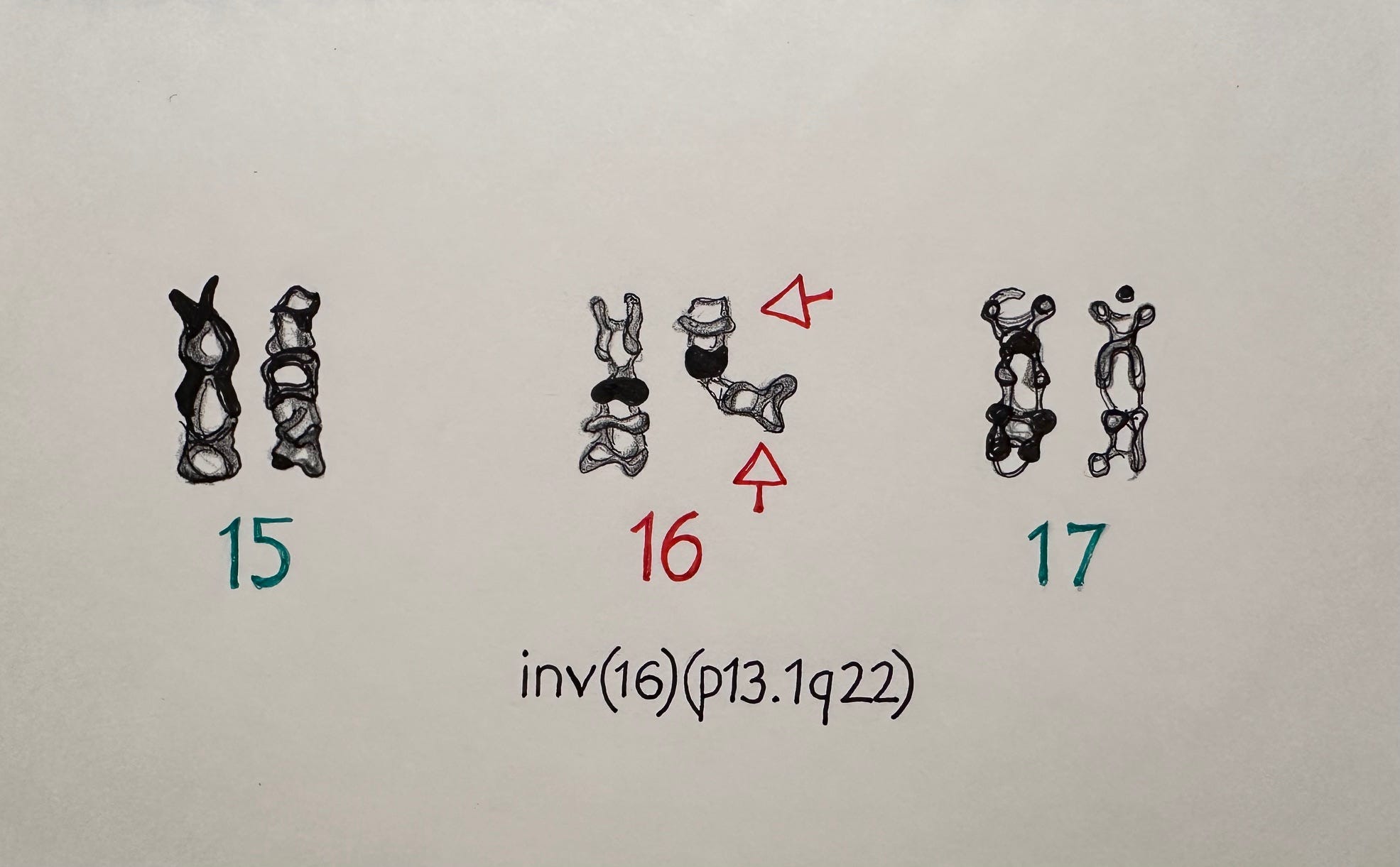
I hadn’t known before of Schlossberg, an environmental journalist and the granddaughter of JFK. But reading her essay recalled my own dance with death. It’s presumptuous, but for a few minutes, I felt I inhabited her grief, her agony, as she prepares to depart her body too soon, leaving her promising writing career, young children, and “perfect” husband behind. All because a single chromosome on a single stem cell got twisted the wrong way.


On that hallucinatory night three years ago, I saw into my marrow: a pink, teeming mass of cellular life inside spongy bone. One blast cell breaks away, twists its DNA in knots. Clones itself once, twice, again. And the clones clone themselves, crowding out the cells that carry oxygen, resisting their own death.
There’s something uniquely terrifying about leukemia. You can’t see it on a scan, cut it out with a scalpel, or radiate it away. And yet—it’s everywhere. Traveling down each vein and artery, each capillary that fractalizes to the finest mesh of red. Perfusing every organ and body system. Your skin, your heart, your brain. And with that, your own blood transforms from giver of life to bringer of death. Unless a stronger poison can vanquish the poison that is your blood.
Like Schlossberg, I had acute myeloid leukemia, AML. But for me, it was the 16th chromosome of a blast cell that flipped upside-down, whereas for her, it was the 3rd. Just that: a different chromosome. A microscopic distinction that means the difference between likely survival (given extreme doses of chemo) and almost certain death.
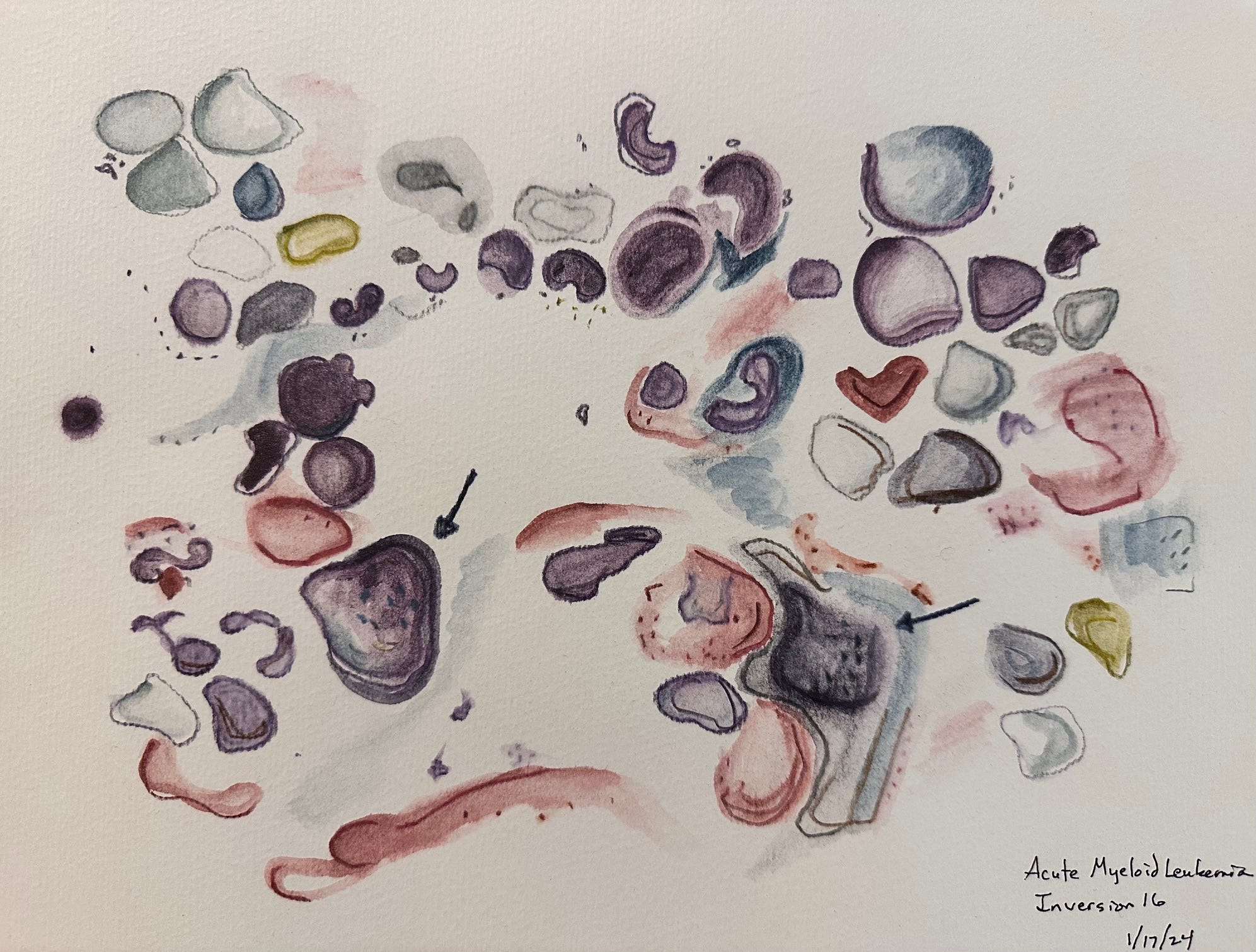
In AML, Inversion 16 is considered a “favorable” mutation (if the word “favorable” can be written in the same sentence as “AML”). The 256 hours of high-dose chemo vanquished the zombie apocalypse in my bloodstream. True, the chemo stripped me skeletal, and sepsis landed me in the ICU. But I managed to avoid the nearly unendurable, months-long process of a bone marrow transplant that Schlossberg has endured, twice. (I’m knocking on wood as I write this, because I’m forever knocking on wood.)
So yes, I cried upon diagnosis—and again five months later, upon receiving news that Inversion 16 was no longer detectable in my bone marrow by the most sensitive test.
And I cried yesterday morning, upon opening my online health portal to view my latest bloodwork results, which read: “(inv 16) det quant.” My brain translated this as “Detected quantity of Inversion 16.” For a few pounding seconds, hospital corridors opened before me and my tingling limbs prepared to flee them. Then my eyes landed on the nurse practitioner’s note: “Good news! This was a negative test.”
Thus, the rare tears—of relief.
A friend asked whether I feel guilt about my survival. I don’t. Just overwhelming gratitude for my continued embodiment. Gratitude that I know, now, how fragile life is, how easily things can flip upside-down. Layered with grief that so many of the best of us die young.
If not our bone marrow, what is the deepest core of us? Schlossberg knows, I think. She’s seeing it. “When you are dying, at least in my limited experience, you start remembering everything,” she writes. She’s “sifting through the sands,” surfacing gems of memories that convey a life.
It’s uncanny, but on the morning her essay was published, I’d written a passage about how, in the hospital, memories fell around me like glitter, like ash. Mom and me dancing barefoot on the gold kitchen tile to “Stayin’ Alive.” Dad and me scrambling up a boulder field in the glaring sun, not talking much. Dad, whose ashes resided awhile in a silver cardboard box on the highest shelf of my hospital room, gazing down.
I’m wrestling with how to tell my leukemia story as part of a larger narrative about Dad and me. How to convey the whole of it without getting lost in the weeds. I have that luxury now, I hope. But when you don’t have much time, you can’t fuck around with a sprawling, complex memoir; you must distill your experience into essay form.
“Being in the present is harder than it sounds,” Schlossberg writes, “so I let the memories come and go.” I partly know, but can also only imagine, how much pain her present brings. But here is the redemption: the beauty of these memories, the love that surrounds her, this electrifying piece.
Your neighbors gathered daily to meditate and pray for your survival. We knew how precarious your condition was. It brings great joy —and relief—to see your beautiful self now!
Thank you for this piece, Kristin -- electrifying in its own way. You and Tatiana and others have crossed the terrain of near death and brought back gifts to share with all of us. I just finished When Breath Becomes Air by Paul Kalinithi, another memoir that treads the same territory. Well worth reading. It takes courage to write from that place. I am grateful for your skill as a writer and your generosity as a human being.